How I planned a family trip with Claude
A pile of booking PDFs, four wishlists, and nine days in New York. Here's how Claude turned it all into the single file that ran our family trip.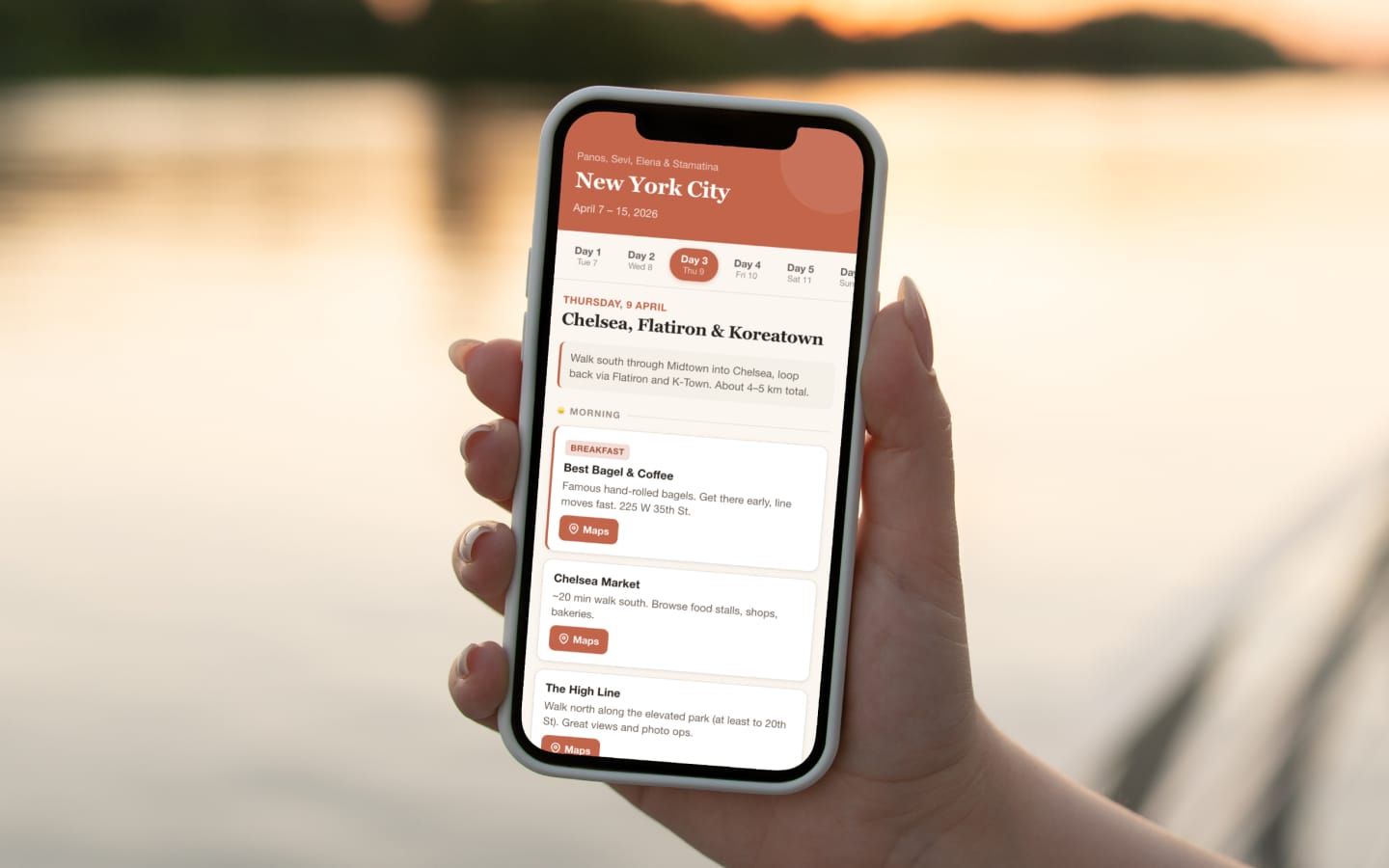
We were three days into New York when I noticed the phones. Elena had hers out on the R train, checking something. Stamatina was scrolling in Bryant Park. Sevi was consulting hers over breakfast. All four of us, at different times, opening the same file. Nobody had told them to. It was just the thing you'd check.
The file was a single HTML page sitting on our phones, with tabs for each of the nine days. Every activity showed its time, address, confirmation number, a Google Maps link, and any note that might matter (opening hours, closing days, entry windows, bag rules). Because it ran offline, subway signal was never a problem, and when someone on the platform asked "wait, what time is the FRIENDS thing?" nobody had to dig through email to answer.
I didn't write it. I asked Claude to.
AI is impressive. You already know that. What I want to talk about is how much most of us are still leaving on the table. Getting to the file that ran our trip took an afternoon of work, not a weekend. If you've been treating Claude, ChatGPT, or Gemini as fancy search, or as a chat toy, or as an email polisher, you're using a fraction of what they can now do.
Here's what changed for me, and how you can copy it.
Where I'm coming from
I've written about trip planning before. A couple of years back, I posted my Craft-based travel template, which I still stand by. The fundamentals hold up: gather points of interest, group them by neighborhood, structure the trip day by day, and add a Google Maps link to each entry. If you don't want AI in your planning, that template is still a solid starting point.
New York was different. The planning problem outgrew the template, and the tools available to handle it got dramatically better.
The mess I was working with
Nine days, four of us, and a route that took us across two continents with a stopover in each direction.
By the time we sat down to plan, I had accumulated a pile that looked like this:
- Airlines. Three flights across two carriers, each with its own bag rules, terminal quirks, and check-in windows. One connecting airport had our two carriers operating from different terminals, easy to miss when you're skimming a PDF at 11 PM.
- Ground transport. A stopover hotel on the way there. Two airport taxi confirmations, one each way, with a service that promised to track our flight so the driver would wait if we ran late.
- The hotel. A welcome PDF that quietly listed perks nobody was going to read: a bike pass, discounts on a couple of nearby attractions, 10% off Krispy Kreme.
- Paperwork. ESTA approvals for all four of us.
- Pre-booked tickets. A couple of things reserved ahead, each with its own entry window and confirmation code.
- Four wishlists in four formats. My daughters' shared Instagram saves. Sevi's rooftop bar bookmarks. My own list including Micro Center, a 30,000 square foot tech store I'd been circling for months. Screenshots, Threads posts, verbal "we should see this" from the family chat.
- A geography. Activities scattered across four different neighborhoods, with no natural order to them.
This is the sort of pile that used to eat weekends: cross-checking dates, building a shared spreadsheet, chasing down confirmation numbers, sorting activities by neighborhood. It's not hard work. It's just slow, and nobody in a family of four is queuing up to do it.



The move most of us aren't making yet
Claude, ChatGPT, Gemini, and a handful of others have quietly gotten very good at the same thing: absorbing unstructured input and giving you back something structured and specific. The result is a working artifact you can actually use.
Most people never point them at a real mess. That's fine, but they can handle far more than we're asking of them.
The move almost nobody makes is this: "Here is every document, email, note, PDF, and screenshot I have on this project. Read them all. Figure out what matters. Give me back something I can actually use."
My most useful prompt this year: "Here's everything, help me make sense of it."
The gap between what people think these tools can do and what they can actually do is now measured in days or weeks of skipped work.
What I actually did
Here's the workflow, at a level of detail you could copy.
Started a dedicated Claude Project (a workspace where all my files and chats stay together). Every file I uploaded and every conversation stayed in one place. ChatGPT has the same feature with its own projects, and if your tool doesn't offer that, a single long thread works fine too.
Fed it everything. Booking PDFs, confirmation emails, the hotel welcome document, the wishlists, notes I'd made on my phone. I didn't retype anything. I didn't clean anything up. I forwarded emails as they arrived, dropped PDFs in without opening them, pasted screenshots straight from my camera roll. The whole point was not doing that work.
Prompted with intent, not instructions. Not "make me an itinerary" but something closer to "four of us, nine days, here's what everyone wants to see, here's what's already booked, here are the constraints. Group things by neighborhood. Keep energy levels in mind, so the day after the transatlantic flight is a light day. Sunday will be dedicated to family we're meeting there. I want Empire State at sunset."
Went back and forth with Claude over a few sittings. The first draft had days that were too dense, so I moved things around. One food stop felt orphaned, and when I flagged it, Claude paired it with Micro Center that same afternoon. I hadn't told it they were two blocks apart; it worked out the geography on its own.
Asked for the deliverable I actually wanted. Not "give me a document" but something specific: a single-file HTML page I could open on my phone without an internet connection, tabbed by day, color-coded by category, with a Google Maps deep link on every activity and booking confirmation sitting inline with the thing they were booked for. That level of specificity turned out to matter more than any clever prompt.
I used Claude. If you prefer ChatGPT or Gemini, the process is nearly identical. The tool you pick matters less than giving it the whole picture.

Why it held up in the field
There's a difference between a plan that looks good on paper and a plan that survives contact with a subway platform. Here's what made this one work.
Every answer was where I needed it. The FRIENDS card had the 3:00 PM entry, the 30-minute window, the address, and the confirmation number all on the same card. Empire State had the 6:30 PM slot, the order reference, and the price. The hotel perks were pulled out of the welcome PDF and dropped into day two, so nobody missed the Citi Bike Pass or the observatory discount. When one of my daughters asked about the Krispy Kreme code on day five, I didn't have to look for it.
Details that would have caused real trouble showed up early. One of our flights only included small cabin bags by default. Hold luggage had to be added in advance through the booking site. Claude flagged it as a task to handle before we left, not a surprise to discover at bag drop. The terminal shuttle at our connecting airport was factored into the arrival day because our two carriers operated from different terminals, and I would have overlooked it. A photobooth we wanted to visit only fits two or three people, so Claude noted that a family of four would need two rounds. Small catches, but the kind of small catches that turn into arguments when you're tired.
It filled in what I didn't. Some of the shops on my daughters' list came from TikTok videos: just a name and a vibe, no address. I dropped the names in without doing any lookup work, and Claude came back with a full Google Maps link on every one. I hadn't asked. It just did the work.
The format was built for the way we'd actually use it. We'd be on a phone, on the move, checking something in three seconds while a train pulled in. A sticky tab bar at the top let anyone jump between days without scrolling. Every card was small enough to answer one question at a time. Even the subway lines were rendered in their real MTA colors, so when the page said "take a red 1/2/3," it looked like the signs on the platform.
It worked offline. There was nothing to install and nothing to sign into, and I never had to worry about an update prompt appearing at the worst possible moment. It lived in iCloud, opened as a bookmark on all four phones, and never once needed a connection.
By day three, nobody was asking me for details anymore. They just checked the file.
This isn't just about travel
The workflow I've described has nothing to do with travel. It's about what happens when you take a pile of documents you'd normally sort through by hand and hand the whole pile over.
The same shape shows up everywhere once you look for it: house renovation quotes from three contractors you're trying to compare, wedding logistics, researching a big purchase across fifteen open tabs, a project handoff at work, moving countries, tax paperwork. Anything, really, where the problem is "I have a lot of unstructured material, and I need something specific out of it."
The bottleneck was never the AI. It's how much of the mess we're willing to hand it.


What to try next
We already have a couple of trips forming for later this year, and I'm not planning any of them the old way. The Craft template will still get its use when I'm helping friends plan without walking them through AI tools. But for anything my own family is taking on, the workflow is settled: gather everything, describe what I want, iterate, ship a phone-friendly artifact.
If you've been using Claude, ChatGPT, or Gemini for tidy little tasks, try something small this week. Forward a batch of newsletters you've never opened and ask which are worth keeping. Drop a folder of receipts in and ask what you spent last month. Both take a couple of minutes to set up, and either one might change how you think about the tool.
The worst-case is that you save an afternoon. The best case is your teenage daughter starts opening the file on the R train.