From Claude Code chaos to Subspace: Running every AI agent in one macOS app
Subspace brings every AI coding agent into one keyboard-first macOS workspace, with cross-agent memory that finally puts an end to the constant context re-explaining.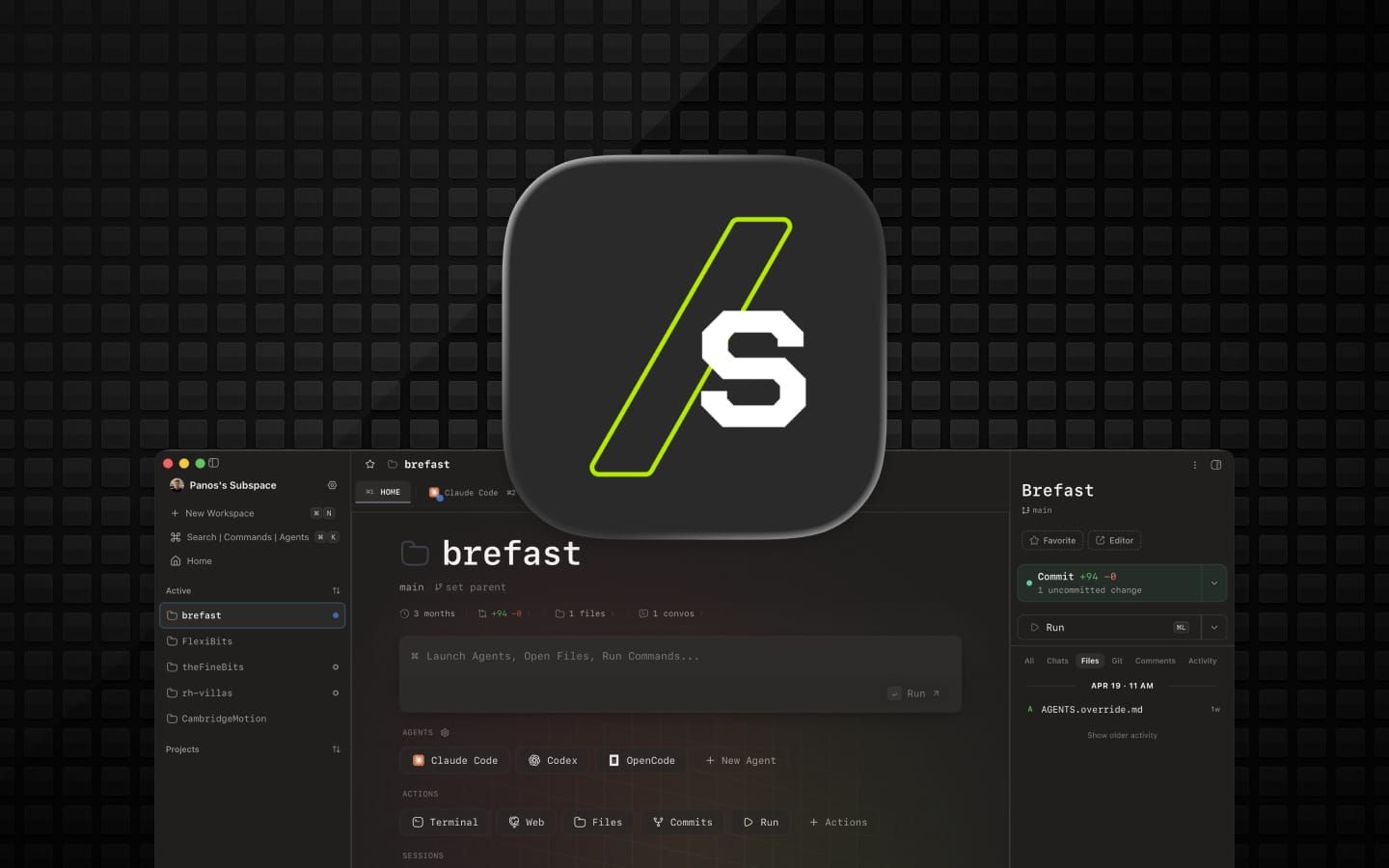

You know that moment when you've sent Claude Code a complex request, the cursor's been blinking for two minutes, and you decide you might as well spawn a new instance to keep things moving? That's the kind of small friction that quietly stacks up over a workday. Multiply it by switching between projects, juggling terminals, hopping between agents (because Claude isn't always the right tool for the job), and you've got a workflow that's faster than ever and somehow more chaotic than ever.
I've been testing tools that try to solve this. The most recent one, Subspace, genuinely surprised me. Enough that I committed to paying before my trial was even up. Here's why.
A quick note on how I actually work
Product design isn't what it used to be. The traditional flow (design in Figma, hand off to dev, hope the result doesn't make you flinch) is being replaced by something more direct. Most of the time, when I want to test an interaction or validate a UI idea, I just ask Claude to build it in code. It's faster than mocking up the same thing in Figma, and there's a decent chance the dev ends up using my code anyway. I touched on this broader trend in my piece on vibe coding, and a bit earlier on leveraging AI as a product designer. It keeps becoming more true.
This means I'm running AI agents almost constantly. Building Brefast, iterating on all my Ghost themes (including theFineBits), prototyping ideas on the side. Multi-agent juggling isn't a power user fantasy for me; it's the default Tuesday.
So, what is Subspace?
Subspace is a macOS app that lets you run Claude Code, Codex, OpenCode, and a growing list of other agent CLIs side by side in a single workspace. The tagline is "All your Agents. One app. Zero amnesia," and once you understand what that "zero amnesia" part actually means, it stops sounding like marketing.
You get your agents alongside terminals, files, a browser, git, and docs. Everything is organized into projects you can switch between in a fraction of a second.
Cross-agent memory is the feature that sold me
Most multi-agent tools I've tried do the obvious thing. They let you run several agents in different panes. Useful, but each agent still lives in its own bubble. Hand a task off to Codex after Claude Code has been working on it for an hour, and you're back to re-explaining what's been tried, what failed, and what you eventually decided.
Subspace builds memory in the background. Every conversation gets compressed into structured notes (decisions, blockers, progress), and that memory belongs to the workspace, not to any one agent. So when I'm working on Brefast and Claude Code gets stuck on something gnarly, I can spawn a fresh instance, or switch to Codex entirely, and the new agent already knows the context. No catch-up. No copy-pasting the last forty messages.
This sounds like a small thing on paper. In practice, it's the difference between a smooth handoff and a five-minute reset.
All my tools under one roof
We're in an era where almost everyone is coding one way or another. Designers, marketers, founders, hobbyists. The old separation between "tools for builders" and "tools for everyone else" is dissolving. So having the terminal, files, browser, git, and your AI agents living together in one app stopped feeling like a nice-to-have and started feeling necessary.
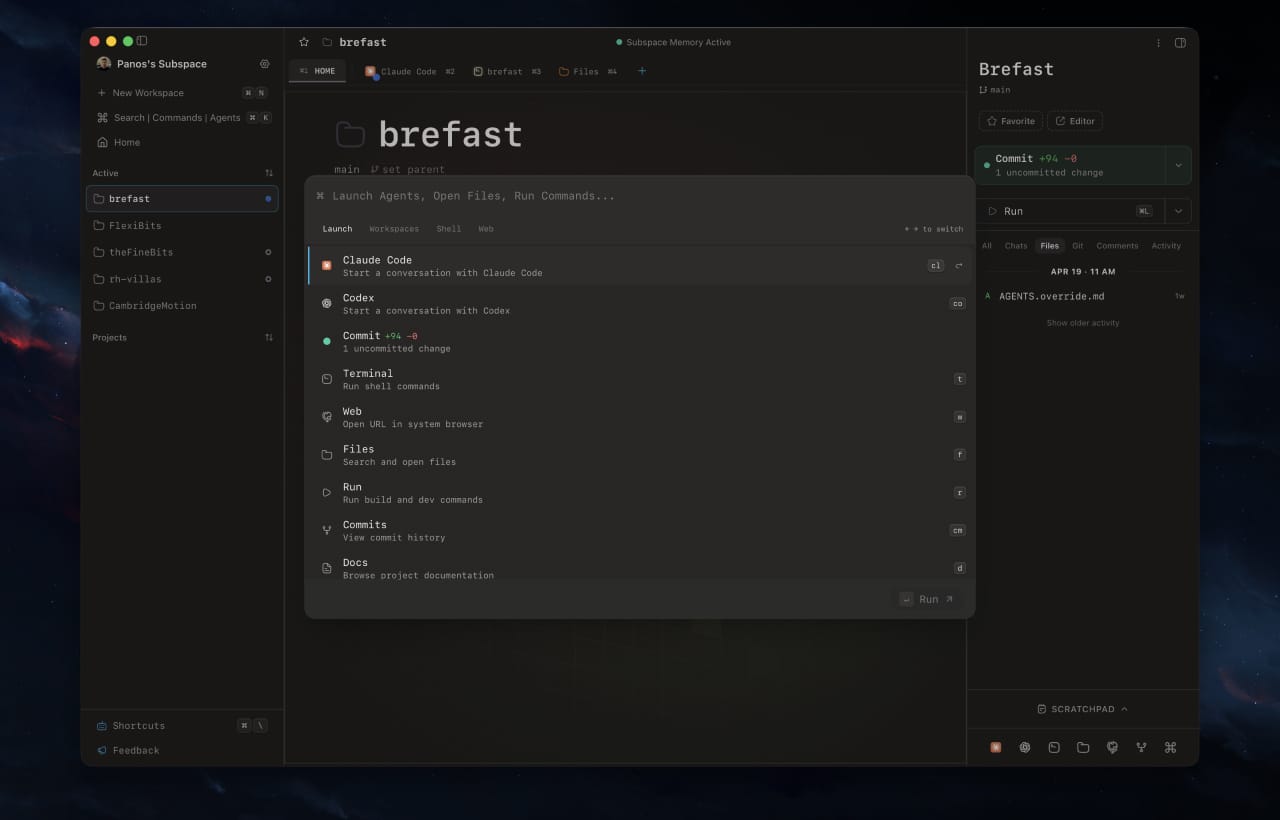
Subspace nails this. The keyboard-first command palette (Cmd+K) handles almost everything: launching agents, switching workspaces, opening files, and running shell commands. If you've enjoyed Raycast, you'll feel right at home. I barely touch the trackpad when I'm working in Subspace.
The browser pane is another quiet surprise. Highlight a piece of UI on your live site, leave a comment, and the agent gets the request with the exact source file and React component already attached. For a designer who likes to point at things and say "fix this," it's hard to go back to anything else.
Spawning new agents and switching projects
Remember that opening scenario? This is where it pays off. When Claude Code is grinding away on something complex, I just open the command palette and spawn another agent. The new instance automatically picks up the workspace's memory, so I'm not starting from scratch. One agent can refactor while another writes tests, both in the same window, both aware of what's been happening.
Switching between projects is just as fast. Brefast in one workspace, theFineBits in another, side experiments in a third. Project switching is genuinely under 100ms, which sounds like a marketing number until you actually feel it. No waiting, no reloading, no losing your place.
The Conductor question
If there's a tool I'd call a real competitor to Subspace, it's Conductor. Equally polished, feature-rich, clearly built by people who care about the craft. But Conductor's worktree-only model feels like overkill for my solo setup. I don't always need that level of git isolation, and having it forced on every session adds friction I'd rather not deal with.
Worth trying if you're curious. For me, Subspace's looser, more workspace-oriented approach was the better fit.
About the pricing
Subspace is $12/month or $99/year, with a 14-day free trial that doesn't require a credit card upfront. There's also a free plan, but it caps you at one project (read-only for extras), offers only basic features, and, crucially, no memory. Enough to kick the tires, not enough to feel what makes Subspace worth using in the first place.
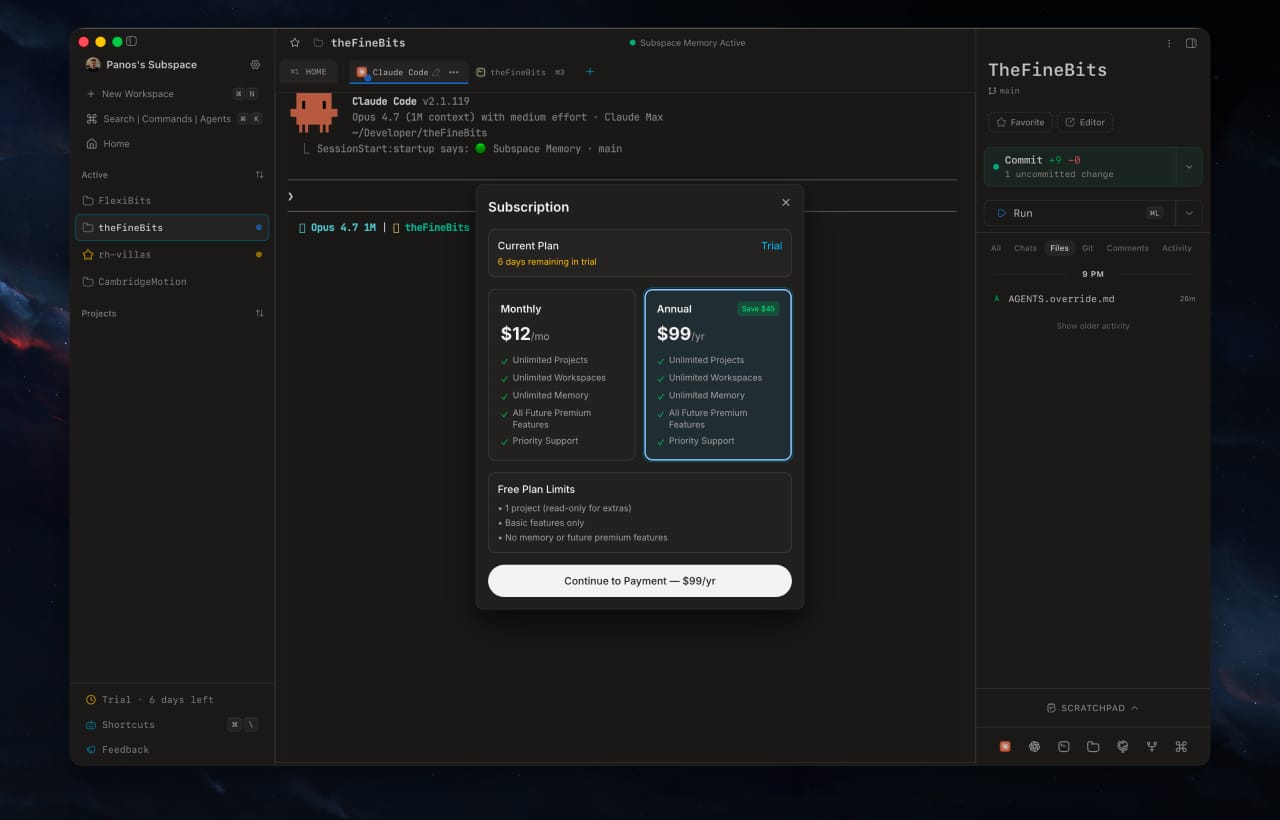
The trial is the better introduction, and it sold me on it. The speed, quality, and rate at which the team ships updates do most of the work. If you're already burning through AI tokens daily, $12/month is a reasonable line item, and it pays for itself the first time cross-agent memory saves you from re-explaining a complex task.
Closing thoughts
We're somewhere in the middle of a big shift. Designers, developers, and everyone in between are finding their workflows reshaped by AI agents that are increasingly capable and increasingly plural. The tools we use should reflect that, and most of them haven't quite caught up yet.
Subspace is the cleanest answer I've found to the multi-agent juggling problem. It's not perfect (cross-agent memory currently spans Claude Code, Codex, and OpenCode, with more on the way), but it's the only tool I've used that treats memory as a first-class workspace concept rather than an afterthought. For someone juggling Brefast, theFineBits, and a handful of side projects at once, that upgrade matters more than it sounds.
If you're spending half your day in conversation with one AI agent or another, give it a shot.